


Warts are a contagious skin disease.The causative agent is human papillomavirus.They are small tumor-like benign skin structures that look like nipples or nodules.Generally, they are not inflammatory in nature.
You can get papillomavirus from contact with sick people (including sexual contact), household items, bedding, towels, toys, tableware, and skin lesions.The incubation period ranges from 2 weeks to 2-3 months.
If the warts are small and cause no discomfort, you can leave them alone.If they come into contact with mechanical friction against clothing, cause pain when touched, or cause physical or psychological discomfort, doctors recommend throwing them away.
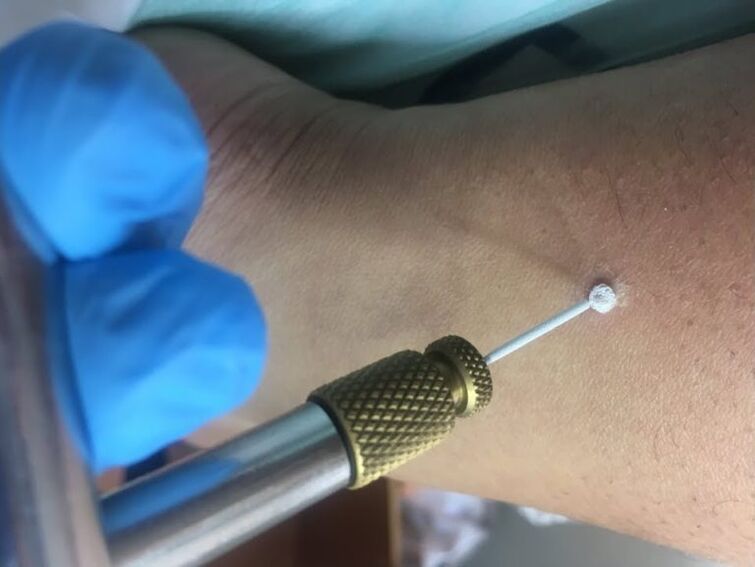
How to remove warts
Today, modern medicine offers several effective medical treatments for wart removal.These are the following methods:
- laser burning;
- freezing damage;
- surgical removal;
- Electrocoagulation.
Let’s take a closer look at each method of removing skin lesions.
laser
Laser is currently considered one of the most effective methods of removing skin tags.The method is painless, highly effective, and minimizes consequences and complications such as scarring, scarring, and skin hyperpigmentation.
The device's main function is to vaporize (erbium laser) or coagulate skin cells (carbon dioxide laser).The laser works by photomechanically destroying wart tissue and sequentially removing its layers through the device.Light energy is converted into heat energy, which helps break down the skin's structure.
Instructions for use
Any type of wart can be removed with laser:
- sole of foot;
- ordinary growths on the body;
- Flat.
Laser cauterization of warts is performed layer by layer using local anesthesia.This process lasts several minutes.Laser penetration depth and exposure time depend on the depth and location of the buildup.A small depression remains at the growth site; after a few weeks, the condition stabilizes.
No special skin care is required after the growth is removed with a laser beam.After 2-5 weeks, the dimples that form will flatten out on their own.If a growth develops on your feet, you should protect your feet from excessive pressure for two weeks.
Contraindications
Despite the many advantages of laser, it still has some contraindications.It cannot be used in the following situations:
- high temperature;
- Colds (ARVI, acute respiratory infection, influenza, sore throat);
- hypertension;
- Herpes infection is present in the acute phase.
Pregnant and nursing mothers must use extreme caution when using lasers and only after consulting a doctor.
freeze damage
This method involves the use of liquid nitrogen.Skin tags are exposed to low nitrogen temperatures.As a result of deep freezing, tissue death occurs.That is, the changed skin cells are greatly cooled under the influence of nitrogen, as a result of which the water inside the cells freezes.When water freezes, it expands, causing cells to burst and die.Education simply ceases to "live", collapses and dies.
Instructions for use:
- Warts change shape or color;
- The formation is constantly hurting, hurting, itching, itching, and bleeding;
- Whole body formation growth;
- Cosmetic defects in appearance;
- located on the labia;
- At patient's request.
The procedure is performed in various ways - hardware (cryoprobe) or manually (special applicator, 25-30 cm long).Manual methods are more commonly used than hardware methods.
Use novocaine or lidocaine for anesthesia.Dip the applicator with wrapped cotton wool into the container of nitrogen and apply gentle pressure to the affected area.The operation time is 10-30 seconds, depending on the size of the wart.After the first operation, pause for 1-2 minutes to observe how the nitrogen affects the tissue.When frozen with nitrogen, the growth begins to turn white and then becomes whiter and denser in structure.This process can be repeated 3-5 times with an interval of 3-5 days.
The next day, a bubble will appear in this place.This is normal and there is no need to panic.It may be reddish or whitish.If the bubbles are small and don't bother you, there's no need to open it.It will open on its own after 5-6 days.New, youthful skin forms underneath.If the bubble is large and starts to hurt due to the pressure of the liquid inside, it can be opened carefully.It is best to have this done by a doctor to avoid infection.If you don't want to go to the doctor, you'll need to open it with a sterile needle preheated over a fire.After puncture, treat the wound with antiseptic.Place a gauze bandage on top and wrap with bandage.For pain, you can take painkillers.
One week after the surgery, the skin surface darkened, began to peel, and the growths disappeared.When treating and exfoliating, apply a 2% salicyl alcohol solution to the skin.
Contraindications
There are no contraindications to this method.Nitrogen can be used by children and pregnant women.Complications can occur if done incorrectly or if post-procedural wound care rules are violated.
surgical resection
If the wart is too large, deep, flat, and takes up a large area of the body, the wart may need to be removed surgically.The surgery is performed using a scalpel under local anesthesia.Skin structures are excised and intradermal cosmetic sutures are performed.They will be removed after a week.After such surgery, a small, light, thin and flat scar of 2-3 mm in length will be left.An absorbable silicone patch is applied over it for rapid healing.
After surgery, it is forbidden to go to the solarium and bathroom, or to peel off the resulting scabs.Do not get the wound wet for the first week, treat it only with antiseptic and maintain hygiene.
Contraindications:
- pregnancy and lactation;
- worsening of herpes;
- Inflammatory and infectious processes in the body.
electrocoagulation
This method involves the use of an electrocoagulator.Electric shock can remove any type of wart, except plantar warts because of their thicker structure.
The surgery is performed using local anesthesia.A high-frequency current is supplied to the metal ring.It cuts off growth and coagulates surrounding tissue.The surrounding tissue is heated, thus preventing bleeding and further spread of the virus to healthy areas.
After exposure to electrical current, a crust will form; it will disappear on its own after 7-10 days.The wound must be treated with antiseptic and not wet with water.A slight, flat scar may be left.
Contraindications:
- Hypocoagulation;
- intolerance to electrical procedures;
- worsening of herpes;
- neoplastic diseases;
- Chronic disease worsens.
Many people are concerned about this question: Is it better to remove warts with laser or nitrogen?Lasers offer many advantages over other methods of removing growths, including:
- Speed of surgery (2-3 minutes);
- No scars or blemishes;
- painless;
- Rule out infection during operation;
- No risk of damaging healthy areas;
- The possibility of recurrence is minimized;
- There are almost no contraindications.
As for nitrogen, it can be used by children and pregnant women, has no contraindications, is affordable, and the procedure is quick.But if the technique is violated, scars may remain.Wounds must be cared for carefully.There may be relapses.
Nowadays wart removal with nitrogen is also considered an effective treatment, but it is important that lasers still work more accurately, painlessly and leave no trace.
It is recommended to combine the described method of wart removal with general anti-relapse treatment.
The likelihood of warts re-forming depends on the quality and timeliness of the surgery, as well as the status of the immune system.Well, to find out which removal method is right for you, it’s best to seek advice from your doctor.